
Imagine 2 people looking at the same Kèo Nhà Cái before a Bundesliga fixture. The first goes with their gut they’ve watched this team a lot, they feel confident about the home side. The second pulls up the last 8 match xG differentials, checks the line movement since opening, and sees that the Asian handicap shifted 0.25 in favor of the away team 3 hours ago despite most public action going the other way.
Same match. Different decisions. Different foundations.
keonhacai95.com is built around the second approach. The site applies data analysis to Kèo Nhà Cái coverage rather than presenting previews driven by intuition dressed up as expertise. Whether that distinction changes betting outcomes over time is ultimately for individual bettors to judge. But understanding what data-driven analysis actually involves and what it doesn’t is worth working through properly.
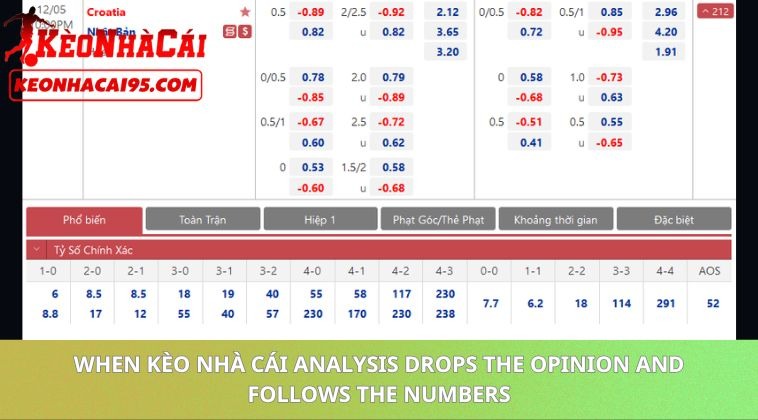
What Data-Driven Actually Means Here
Starting from Numbers, Not Narratives
Most football commentary starts from a narrative. Team A is in good form. Team B lost their last 3. The manager looks nervous in press conferences. These observations aren’t wrong, but they’re selected after the fact to support a predetermined view of the match.
Data-driven Kèo Nhà Cái analysis runs in the opposite direction. The numbers come first. What do the xG figures from the last 6 matches show? How does each team perform when playing away from home against similarly ranked opposition? Has the handicap moved in a direction that suggests informed betting action or just public volume?
The narrative follows from those inputs not the other way around.
What Gets Measured and Why
Here’s the thing. Not all football statistics are equally useful for Kèo Nhà Cái purposes. Some metrics correlate well with future performance. Others look informative but don’t hold up under examination.
Possession percentage, for example, is a popular metric that has weak predictive value on its own. A team can dominate possession and lose repeatedly because they’re generating low-quality chances. xG (expected goals) is more useful because it assigns quality weights to shots based on historical conversion rates at similar positions under similar conditions.
Similarly, goal difference over a full season looks informative. Goal difference adjusted for opponent strength is more informative. These distinctions matter when you’re applying analysis to a Kèo Nhà Cái decision with real stakes attached.
Kèo nhà cái analysis at KEONHACAI95 applies this kind of metric weighting to featured match coverage using indicators with demonstrated predictive relevance rather than defaulting to the statistics that show up most prominently in broadcast coverage.
Where Opinion Still Has a Role
Honestly, pure data analysis has limits in football. The sport has more variance than most statistical models fully account for. Weather conditions, referee tendencies, fatigue from a midweek fixture, the psychological state of a squad after a poor result these factors resist quantification but affect match outcomes.
A data-driven approach doesn’t pretend these don’t exist. It uses them as adjustments to the baseline numbers rather than as the primary basis for a Kèo Nhà Cái assessment.
The editorial team at KEONHACAI95 treats this as a 2-layer structure. Layer 1 is the quantitative foundation xG, odds movement, form metrics, head-to-head filtered for recency. Layer 2 is the qualitative adjustment what contextual factors aren’t captured in the numbers and how much weight they deserve in the final assessment.
Keeping these layers separate matters. It means the quantitative foundation can be examined independently. If a bettor disagrees with a qualitative adjustment, they can still use the underlying data layer.
When the Data and the Narrative Conflict
This happens more often than most analysis sites admit. The numbers point one way, the obvious match narrative points another.
A home side on a 5-match winning streak playing a team that’s lost 4 on the road sounds straightforward. But if that home side has been winning against weak opposition, their xG differential against comparable teams is poor, and the Kèo Nhà Cái line has drifted away from them despite heavy public support the narrative and the data are in tension.
That tension is actually useful information. It means the market is pricing the fixture differently from how casual analysis would suggest. Worth investigating why.
(Collected from: https://keonhacai95.com/ analytical methodology and featured match coverage)
Applied Example Reading a Kèo Nhà Cái Through a Data Lens
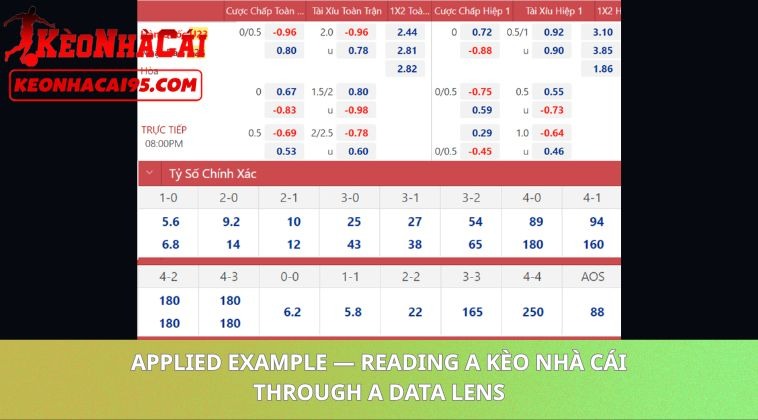
Take a specific scenario. A Southeast Asian fixture with a -0.5 Asian handicap in favor of the home side. The public narrative: home advantage, recent form, and a quality gap between the squads.
A data-driven approach checks several things before accepting that narrative.
First, how does the home team actually perform at home against direct competition? Not their record against weaker sides, but against opponents in a similar quality range. Second, what does the away team’s defensive xG look like over the past 6 matches? If they’re conceding 0.9 expected goals per match but actually conceding 1.6, they may be in a worse defensive position than their results suggest. Or they might have a goalkeeper significantly outperforming their xG, which tends to normalize over time.
Third, and this gets overlooked: has the -0.5 line held since opening? A home favorite at -0.5 that opened at -0.75 and has drifted toward the away side suggests the market has revised its initial assessment. That revision reflects something.
None of this produces a definitive answer. Football doesn’t work that way. But it changes the quality of the question being asked before money goes on the Kèo Nhà Cái.
The Gap Between Analysis and Execution
One thing data-driven Kèo Nhà Cái coverage can’t do is make betting decisions for bettors. The analysis provides inputs. Execution is still personal.
This sounds obvious. Less obvious: the same data can lead different bettors to different conclusions based on their risk tolerance, their familiarity with specific competitions, and how much confidence they require before acting. A 55% implied probability on 1 side of a Kèo Nhà Cái might be enough for 1 bettor to act and not enough for another. That’s not an analytical failure. That’s individual judgment applied to a shared information base.
What good analysis does is narrow the range of uninformed decisions. A bettor using KEONHACAI95’s data-driven Kèo Nhà Cái coverage isn’t getting certainty. They’re getting a cleaner set of inputs than they’d have assembled from instinct alone.
Conclusion
Data-driven Kèo Nhà Cái analysis starts from numbers and builds toward narrative rather than starting with a story and selecting data to support it. KEONHACAI95 applies this approach across featured match coverage using xG, line movement, recency-filtered form data, and odds comparisons to build assessments that can be examined and challenged rather than just followed. It doesn’t remove uncertainty. Football never does. But it gives Vietnamese bettors a more reliable foundation for Kèo Nhà Cái decisions than the alternative.
