
A beginner looking at a multiplication chart for the first time sees a lot of numbers. Rows and columns. Dozens of boxes. It can look like a maze. But here is the secret. That same chart, used the right way, turns confusion into confidence faster than almost any other method.
The problem is that most beginners get handed a chart and told to “use it.” No one explains how. No one points out the shortcuts. No one shows the patterns that make everything click. That changes now. This guide breaks down simple tricks for beginners using Multiplication Charts 1-1000 as the ultimate reference. No complicated theories. Just practical steps that work.
Why Beginners Struggle With Multiplication
Multiplication looks like memorizing a hundred random facts. 6×7 feels unrelated to 8×4. Nothing connects. Everything feels separate. That is overwhelming for a young learner.
But here is what experienced teachers know. Multiplication is not random. It is full of patterns. The chart makes those patterns visible. A beginner who learns to read the chart correctly stops guessing and starts understanding.
The goal is not to memorize everything in one week. The goal is to learn a few simple patterns. The rest follows naturally.
Trick One: Start Small, Then Grow
A common mistake is handing a beginner a full 1-12 chart on day one. That is too much. Too many numbers. Too many boxes. Too many places to get lost.
Better approach: Start with a 1-5 chart. That is only 25 boxes. Much less intimidating. The beginner learns the basic structure without feeling overwhelmed.
Once the 1-5 chart feels easy, move to 1-7. Then 1-9. Then 1-10. Finally, 1-12. Each step adds only a few new facts. The brain handles small chunks better than big dumps.
What this trick does: Reduces overwhelm. Builds confidence early. Makes progress visible.
Trick Two: Learn the Zero and One Rules First
Some facts are easier than others. Start with the easiest ones. Zero and one are practically free.
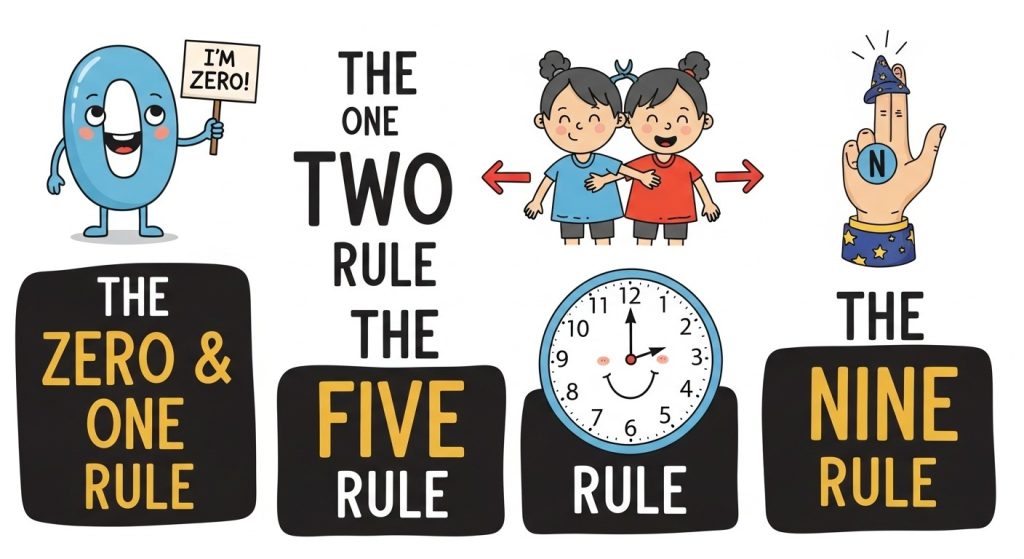
The zero rule: Any number times zero equals zero. Always. No exceptions. 5×0=0. 100×0=0. Zero times anything is zero. That takes seconds to learn.
The one rule: Any number times one equals itself. 7×1=7. 43×1=43. One time, anything is the same number.
These two rules alone cover a bunch of facts. The beginner masters them in five minutes and feels successful right away. That early win matters.
Trick Three: The Two Rule Is Just Doubling
Multiplying by two is the same as adding a number to itself. 3×2 means 3+3. 6×2 means 6+6. Every beginner already knows how to add.
The trick: Say the number. Add it to itself. That is the answer.
3×2 = 3+3 = 6
7×2 = 7+7 = 14
11×2 = 11+11 = 22
The chart shows this pattern clearly. The row for 2 counts up by twos. 2, 4, 6, 8, 10, 12, 14, 16, 18, 20, 22, 24. Every number is even. No odd numbers appear anywhere in the twos row.
What this trick does: Connects multiplication to something the beginner already knows (addition). No new skill required.
Trick Four: The Five Rule Is Easy to Spot
The row for 5 has a dead-simple pattern. Look across the chart. 5, 10, 15, 20, 25, 30, 35, 40, 45, 50, 55, 60.
The pattern: Every answer ends in either 0 or 5. Always. Ends in 0 when multiplied by an even number (2, 4, 6, 8, 10, 12). Ends in 5 when multiplied by an odd number (1, 3, 5, 7, 9, 11).
A beginner who knows the five rules never gets stuck on a five-fact. Just ask two questions. Is the other number even or odd? That decides 0 or 5. Then what comes before? The pattern fills itself in.
Trick Five: The Nine Rule Has Magic Shortcuts
Nine is the trickiest number for most beginners. Until they learn the shortcuts. There are two good ones.
Finger trick: Hold out both hands. For 9×3, put down the third finger from the left. Fingers to the left of the down finger are the tens place (2). Fingers to the right are the ones place (7). The answer is 27. Works for 9×1 through 9×10.
Digit sum trick: Every multiple of 9 up to 90 has digits that add up to 9. 9×2=18 (1+8=9). 9×4=36 (3+6=9). 9×7=63 (6+3=9). 9×12=108 (1+0+8=9). The pattern never fails.
What these tricks do: Turn the hardest set of facts into something almost fun. A beginner who learns the nine tricks feels like they have discovered a secret.
Trick Six: Use Symmetry to Cut the Work in Half
Here is a fact that surprises many beginners. The multiplication chart is symmetrical. Look at the diagonal from top-left to bottom-right. The numbers on one side mirror the other side.
4×3 is the same as 3×4. 7×5 is the same as 5×7. 9×8 is the same as 8×9.
That means a beginner does not need to memorize both. Learn one. The other comes for free.
The practical effect: The chart shows a hundred facts. But the symmetry means only about fifty facts need real memorization. The rest are repeats.
Trick Seven: Skip Counting Along the Rows
Skip counting is just saying the multiples out loud while following along the chart. Pick a row. Say each number in order. 3, 6, 9, 12, 15, 18, 21, 24, 27, 30, 33, 36.
Do this once a day for each row. It takes two minutes. The repetition builds familiarity without pressure.
Why this works: The brain hears the pattern. The eyes see the pattern. The finger moves across the pattern. Three ways of learning at the same time.
How to Read the Chart Correctly
Before using any tricks, a beginner needs to know how to find answers on the chart. The method is simple but must be taught directly.
Find the first number in the left column. That is the row. Run a finger across to the right.
Find the second number in the top row. That is the column. Run a finger down.
The box where both fingers meet holds the product.
Practice these three times with easy facts like 2×3 or 5×4. After that, the method sticks.
Filled Charts vs. Blank Charts for Beginners
A beginner should start with a filled chart. Period. The filled chart is a reference. It gives answers. It reduces frustration. It allows practice without getting stuck.
When to use a filled chart: First two weeks of learning. Any time new facts get introduced. During homework, when the goal is completion, not testing.
When to switch to a blank chart: After the beginner can find answers quickly on the filled chart. When the goal shifts from learning to recalling. For weekly check-ins to see what actually stuck.
Never start a beginner with a blank chart. That sets up failure. The filled chart comes first. Always.
Daily Practice That Actually Works
Five minutes a day beats one hour once a week. Consistency matters more than intensity.
A simple daily routine:
Day one through five: Just look at the filled chart. No active recall. Just let the eyes wander. Passive exposure builds familiarity.
Day six through ten: Practice skip counting one row per day. Monday say the twos. Tuesday says the trees. Keep going.
Days eleven through fifteen: Cover the bottom half of the chart. Try to recall the covered facts. Uncover to check.
Day sixteen through twenty: Switch to the blank chart. Fill what fits in five minutes. Check answers. Circle the misses.
What not to do: Cramming. Timed tests before readiness. Moving to the next row before mastering the current one.
Signs a Beginner Is Making Progress
Progress does not always look like perfection. Here are realistic signs.
Week one: Needs the chart for every single fact. Looks confused. That is normal.
Week two: Finds basic facts (1s, 2s, 5s, 10s) without the chart. I still look up 6s and 7s.
Week three: Remember about half the facts without looking. Starts noticing patterns on the chart unprompted.
Week four: Fills most of the blank chart correctly. Only a handful of facts still need checking.
That pace is realistic. Some beginners move faster. Some slower. Both are fine. The chart stays available either way.
Conclusion
A multiplication chart does not need to be scary. For a beginner, the right approach makes all the difference. Start small with a 1-5 chart. Learn the zero and one rules first. Master the doubling trick for twos. Spot the 0-or-5 pattern for fives. Use the finger or digit sum trick for nines. Remember, the chart is symmetrical, so learning half teaches the whole.
Most importantly, use a filled chart for reference before ever touching a blank one. Five minutes of daily practice beats cramming every time. The tricks above turn a confusing grid into a friendly tool. A beginner who follows these steps will learn faster than expected. And the chart? It stops looking like a maze and starts looking like a map.

