
Welcome to nexttoppers. Managing your time effectively is one of the most valuable skills in both personal and professional life. Whether you’re a student balancing assignments, an employee handling multiple projects, or a business owner managing daily operations, a time management worksheet can help you organize tasks, prioritize responsibilities, and make better use of every hour. Instead of relying on memory or scattered notes, a structured time management worksheet provides a clear roadmap for planning your day, week, or even month.
A well-designed time management worksheet does more than simply list tasks. It helps you identify priorities, estimate the time required for each activity, reduce procrastination, and maintain a healthy work-life balance. In this guide, you’ll learn what a time management worksheet is, why it’s effective, the different types available, and how to use a time management worksheet to improve productivity. You’ll also find practical examples, useful techniques, and answers to common questions to help you get the best results.
What Is a Time Management Worksheet?
A time management worksheet is a practical planning tool that helps individuals organize their daily, weekly, or monthly responsibilities in a structured way. Whether you are a student, employee, entrepreneur, or homemaker, a time management worksheet makes it easier to prioritize tasks, allocate time wisely, and monitor your progress. Unlike a simple to-do list, it provides a complete planning system that helps reduce stress, improve productivity, and ensure important tasks are completed on time. By using a time management worksheet consistently, you can build better planning habits and achieve both short-term and long-term goals more effectively.
Definition
A time management worksheet is a structured document that can be used in printable or digital form to organize tasks and manage time efficiently. It allows users to record their responsibilities, estimate the time needed for each activity, assign priorities, and track completed work. This organized approach helps eliminate confusion and provides a clear direction for the day.
Regardless of whether you use a notebook, printable PDF, spreadsheet, or productivity app, the purpose of a time management worksheet remains the same—to help you stay organized, avoid procrastination, and make the best use of your available time. It encourages disciplined planning and supports consistent productivity in both personal and professional life.
Why People Use Time Management Worksheets
People use a time management worksheet because it provides a clear overview of their responsibilities and helps them stay organized. Instead of relying on memory, they can plan tasks, prioritize important work, and create a realistic schedule that reduces stress and improves efficiency. Having everything written in one place also makes it easier to avoid missed deadlines and manage multiple responsibilities.
A time management worksheet is useful for people from all walks of life. Students use it to manage classes and assignments, professionals organize meetings and projects, entrepreneurs plan business activities, and families coordinate daily routines. By using a time management worksheet regularly, individuals can improve productivity, maintain better work-life balance, and develop strong time management habits that support long-term success.
Benefits of Using a Time Management Worksheet
A time management worksheet offers much more than a simple way to record tasks. It helps you organize your schedule, prioritize important activities, and manage your time more efficiently. By using a time management worksheet regularly, you can reduce stress, improve productivity, and develop better planning habits. Whether you are a student, professional, entrepreneur, or homemaker, this tool provides a structured approach to managing daily responsibilities and achieving your goals more effectively.
Improves Productivity
One of the greatest benefits of a time management worksheet is its ability to increase productivity. When every task is planned and assigned a specific time slot, you spend less time deciding what to do next and more time completing meaningful work. A well-organized schedule also helps you stay focused, reduce distractions, and avoid wasting valuable time on unimportant activities.
In addition, a time management worksheet minimizes multitasking, which often leads to reduced efficiency and unnecessary mistakes. By concentrating on one task at a time, you can complete work more accurately and in less time. For example, scheduling separate blocks for meetings, emails, and project work allows you to maintain focus and produce higher-quality results throughout the day.
Reduces Stress
Managing multiple responsibilities without a clear plan can feel overwhelming. A time management worksheet helps reduce this pressure by organizing all your tasks in one place, giving you a clear overview of your daily schedule. Instead of worrying about forgetting important responsibilities, you can confidently follow a structured plan.
Using a time management worksheet also helps you meet deadlines more consistently and avoid last-minute rushes. Knowing exactly what needs to be done and when allows you to stay calm, work efficiently, and maintain a healthier balance between your personal and professional life.
Helps Prioritize Tasks
A time management worksheet makes it easier to identify which tasks deserve your immediate attention. Since not every responsibility is equally important, organizing tasks by priority ensures that your most valuable work is completed first while less urgent activities can be scheduled for later.
Many time management worksheets use priority levels such as High, Medium, and Low, making decision-making much simpler. This approach improves time allocation, prevents unnecessary delays, and helps you achieve your daily goals without becoming overwhelmed by less important tasks.
Builds Better Habits
Using a time management worksheet consistently encourages positive habits that improve both productivity and personal discipline. Planning your day, reviewing completed tasks, and preparing for future responsibilities gradually become part of your daily routine, making time management easier over time.
As these habits develop, you’ll become more organized, accountable, and focused on achieving your goals. A time management worksheet not only improves your current schedule but also helps build long-term habits that contribute to personal growth and professional success.
Key Benefits at a Glance
A time management worksheet provides several practical advantages that help you stay organized and productive. Some of its most important benefits include:
- Better focus: Helps you concentrate on one task at a time.
- Less procrastination: Encourages you to start and finish tasks on schedule.
- More free time: Efficient planning creates extra time for personal activities.
- Improved work-life balance: Makes it easier to manage both personal and professional responsibilities.
- Increased accountability: Helps you track progress and stay committed to your goals.
Read also: Best Time Management Quotes to Boost Productivity
Different Types of Time Management Worksheets
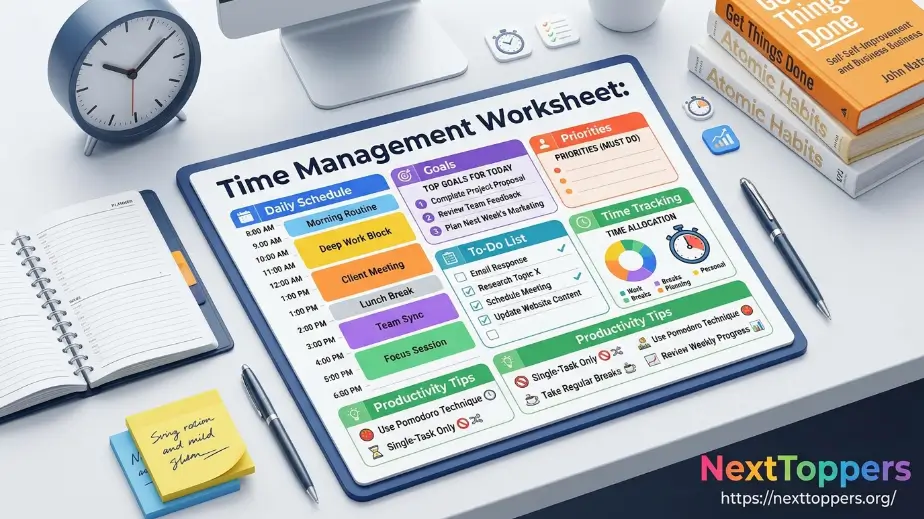
Different people have different responsibilities, goals, and working styles, which is why one time management worksheet cannot meet everyone’s needs. Some individuals need a planner for organizing daily activities, while others require a worksheet for tracking weekly projects, monthly goals, or prioritizing urgent tasks. Choosing the right time management worksheet helps you manage your schedule more efficiently, stay organized, and improve productivity. Understanding the different types of worksheets allows you to select the one that best supports your personal, academic, or professional routine.
Daily Time Management Worksheet
A daily time management worksheet is designed to help you organize all the tasks you need to complete within a single day. It divides your schedule into specific time slots, making it easier to plan activities, manage priorities, and maintain focus throughout the day. By following a structured daily schedule, you can avoid wasting time and ensure that important responsibilities are completed on time.
Using a daily time management worksheet also helps build consistency and accountability. It allows you to monitor completed tasks, identify unfinished work, and make adjustments whenever unexpected responsibilities arise. This worksheet is ideal for students, professionals, freelancers, and anyone who wants to make each day more productive and organized.
Weekly Planning Worksheet
A weekly planning worksheet helps you organize responsibilities across an entire week instead of focusing on a single day. It gives you a broader view of your schedule, allowing you to distribute tasks evenly, monitor deadlines, and prepare for upcoming meetings or important events. Planning your week makes it easier to balance work, study, and personal commitments.
Using a weekly planning worksheet also reduces last-minute pressure because you can identify busy days early and adjust your schedule accordingly. This organized approach improves productivity, prevents scheduling conflicts, and helps you maintain a better work-life balance throughout the week.
Monthly Planning Worksheet
A monthly planning worksheet focuses on long-term planning by helping you organize major goals, project deadlines, appointments, recurring responsibilities, and important events. Instead of concentrating on individual daily tasks, it provides a complete overview of everything that needs attention during the month, making long-term planning much more effective.
This type of worksheet is especially useful for professionals managing multiple projects, business owners overseeing operations, and individuals working toward personal or career goals. Regularly reviewing your monthly worksheet helps you stay organized, monitor progress, and avoid missing important deadlines.
Student Time Management Worksheet
A student time management worksheet is specifically designed to help students organize lectures, assignments, homework, exams, study sessions, and extracurricular activities. It provides a structured schedule that makes it easier to balance academic responsibilities while reducing stress caused by poor planning or last-minute preparation.
Using a student time management worksheet encourages better study habits and improves academic performance by helping students prioritize assignments and prepare for exams in advance. It also creates a health balance between education, personal life, and extracurricular commitments.
Employee Productivity Worksheet
An employee productivity worksheet helps professionals organize meetings, project deadlines, reports, client communication, and daily responsibilities in one structured plan. It makes it easier to prioritize tasks, manage workloads efficiently, and stay focused throughout the workday without overlooking important responsibilities.
This type of time management worksheet is equally valuable for managers because it helps monitor team progress, assign responsibilities, and improve workplace accountability. By following an organized worksheet, employees can increase efficiency, reduce stress, and consistently meet project deadlines.
Time Blocking Worksheet
A time blocking worksheet divides your day into dedicated time blocks, with each block assigned to a specific task or activity. Instead of choosing tasks randomly, you follow a structured schedule that includes focused work sessions, meetings, emails, breaks, and personal activities. This method helps eliminate distractions and improves concentration.
A time-blocking time management worksheet is especially beneficial for professionals, entrepreneurs, and remote workers who require uninterrupted time for important projects. By assigning every activity a specific time period, you can improve productivity, avoid multitasking, and complete work more efficiently.
Eisenhower Matrix Worksheet
The Eisenhower Matrix Worksheet is a popular prioritization method that organizes tasks based on urgency and importance. It divides responsibilities into four categories—Do, Schedule, Delegate, and Eliminate—making it easier to decide which activities deserve immediate attention and which can be postponed or removed entirely.
Using the Eisenhower Matrix with a time management worksheet helps you focus on meaningful work instead of constantly reacting to urgent but low-value tasks. This structured decision-making process improves productivity, reduces unnecessary stress, and ensures that your time is spent on activities that contribute to your long-term goals.
How to Use a Time Management Worksheet Effectively
A time management worksheet is only useful when it is used correctly and consistently. Simply writing tasks on a piece of paper or in a digital planner is not enough to improve productivity. To get the best results, you need a systematic approach that helps you organize responsibilities, prioritize important work, allocate realistic time, and regularly review your progress. By following a few simple steps, a time management worksheet can become a powerful tool for improving productivity, reducing stress, and achieving your personal and professional goals.
Step 1: List Every Task
The first step in using a time management worksheet is to write down every task you need to complete. Include work assignments, meetings, appointments, study sessions, household chores, personal errands, and recurring responsibilities. Recording everything in one place gives you a complete picture of your workload and prevents important tasks from being forgotten.
At this stage, you don’t need to organize or prioritize your tasks. The goal is simply to create one complete list before planning your schedule. Once every responsibility is included in your time management worksheet, it becomes much easier to manage your time and plan your day effectively.
Step 2: Set Priorities
After creating your task list, the next step is to identify which activities are the most important. A time management worksheet helps you organize tasks according to their urgency and importance so that high-priority work is completed before less critical responsibilities. This ensures that your time is spent on activities that contribute the most to your goals.
You can prioritize tasks using simple categories such as High, Medium, and Low or by applying proven methods like the Eisenhower Matrix. Prioritizing tasks reduces unnecessary distractions, improves decision-making, and helps you stay focused on completing your most valuable work first.
Step 3: Estimate Time
Estimating how much time each task requires is essential for creating a realistic schedule. A time management worksheet helps you assign appropriate time limits to every activity, preventing you from overloading your day or underestimating complex tasks. Accurate planning also makes it easier to complete responsibilities without unnecessary pressure.
It is always a good idea to include extra buffer time for unexpected interruptions, urgent requests, or delays. A flexible schedule allows you to adapt to changing circumstances while keeping the rest of your time management worksheet organized and achievable.
Step 4: Schedule Tasks
Once your priorities and estimated times are ready, assign each task to a specific time slot in your time management worksheet. Scheduling creates a structured daily routine that improves concentration, reduces procrastination, and ensures that every important responsibility has a designated place in your day.
While organizing your schedule, avoid filling every hour with work. Include regular breaks to refresh your mind and maintain productivity throughout the day. A balanced schedule is easier to follow and much more effective than an overloaded plan that leaves no room for flexibility.
Step 5: Review Your Progress
The final step is to review your time management worksheet at the end of the day. Checking your completed tasks helps you understand what you accomplished, identify unfinished work, and evaluate whether your schedule was realistic. This simple habit allows you to recognize both your strengths and the areas that need improvement.
Regular reviews also help you improve future planning. By updating your time management worksheet based on daily experiences, you can develop better time management habits, make smarter scheduling decisions, and consistently improve your productivity over time.
Best Practices for Success
Following a few simple habits can help you get the maximum value from your time management worksheet and make your daily planning more effective.
- Prioritize important work: Complete high-priority tasks before less urgent activities.
- Schedule breaks: Take short breaks between work sessions to maintain focus and avoid burnout.
- Track completed tasks: Mark finished tasks to measure your progress and stay motivated.
- Adjust daily plans: Update your time management worksheet whenever priorities change so your schedule remains realistic and manageable.
Free Time Management Worksheet Template
A ready-to-use time management worksheet makes planning faster, easier, and more organized by providing a structured format for managing your daily and weekly responsibilities. Instead of creating a planner from scratch every time, you can simply fill in a pre-designed time management worksheet to record tasks, assign priorities, schedule activities, and track your progress. Whether you prefer a printable planner or a digital version created in Excel, Google Sheets, or another productivity application, using a time management worksheet helps you stay focused, avoid missed deadlines, and improve your overall productivity.
Printable Example
A printable time management worksheet is an excellent option for people who prefer writing their schedules by hand. It provides a simple layout that allows you to organize your tasks, assign priority levels, and monitor completed work throughout the day. Because the worksheet is easy to print and reuse, it can become a valuable part of your daily planning routine.
For the best results, complete your time management worksheet either the night before or at the beginning of your day. Having a written plan makes it easier to stay focused, manage your workload efficiently, and reduce the chances of forgetting important responsibilities. You can also customize the template by adding extra columns or notes to suit your personal or professional needs.
| Time | Task | Priority | Status |
| 8:00–9:00 AM | High | ☐ | |
| 9:00–10:00 AM | Medium | ☐ | |
| 10:00–11:00 AM | High | ☐ | |
| 11:00–12:00 PM | Low | ☐ | |
| 1:00–2:00 PM | Medium | ☐ | |
| 2:00–3:00 PM | High | ☐ | |
| 3:00–4:00 PM | Medium | ☐ | |
| 4:00–5:00 PM | Low | ☐ |
This sample time management worksheet can be adjusted according to your daily schedule and planning preferences, making it suitable for work, study, or personal use.
Daily Worksheet Layout
A daily time management worksheet is designed to help you organize everything you need to accomplish within a single day. It keeps your schedule structured by dividing responsibilities into manageable sections, making it easier to focus on important tasks while leaving enough flexibility for unexpected activities. A well-planned daily worksheet improves organization, increases productivity, and helps you make the most of your available time.
These sections help you organize your workload, monitor your progress, and evaluate your productivity at the end of the day so you can continuously improve your planning habits.
Weekly Worksheet Layout
A weekly time management worksheet provides a complete overview of your responsibilities for the entire week rather than focusing on just one day. It allows you to plan meetings, deadlines, appointments, projects, and personal commitments, helping you distribute your workload more evenly and avoid last-minute pressure. Having a weekly plan also makes it easier to stay aligned with your long-term goals.
Using both a daily and weekly time management worksheet creates a complete planning system that improves short-term productivity while supporting long-term success. Daily worksheets help you manage immediate responsibilities, whereas weekly worksheets provide a broader perspective for achieving larger goals.
Best Time Management Techniques to Combine with Worksheets
A time management worksheet becomes much more effective when it is used alongside proven time management techniques. While the worksheet helps you organize tasks and plan your schedule, productivity methods provide a clear strategy for prioritizing work, maintaining focus, and using your time wisely. Combining these techniques with a time management worksheet enables you to reduce procrastination, improve efficiency, and accomplish more in less time. The following methods are widely recognized for helping individuals create a structured workflow and achieve better results in both personal and professional life.
Time Blocking
Time blocking is a productivity method that involves dividing your day into dedicated time blocks, with each block assigned to a specific task or activity. Instead of working from an unorganized to-do list, you follow a planned schedule that tells you exactly what to work on at a particular time. This approach reduces distractions, prevents multitasking, and allows you to concentrate fully on one responsibility at a time.
When used with a time management worksheet, time blocking creates a well-organized daily routine that improves productivity and time utilization. You can reserve separate time blocks for meetings, emails, deep work, study sessions, and personal activities, ensuring that every important responsibility receives the attention it deserves while maintaining a balanced schedule.
Pomodoro Technique
The Pomodoro Technique is a simple time management strategy that breaks work into short, focused intervals followed by regular breaks. Typically, you work for 25 minutes, take a 5-minute break, and repeat the cycle several times before taking a longer rest. This technique helps maintain concentration and prevents mental exhaustion during extended work sessions.
Combining the Pomodoro Technique with a time management worksheet makes it easier to organize focused work periods throughout the day. It encourages consistent progress, improves concentration, reduces fatigue, and helps you complete tasks more efficiently without feeling overwhelmed by long hours of continuous work.
Eisenhower Matrix
The Eisenhower Matrix is a decision-making framework that helps prioritize tasks according to their urgency and importance. It separates responsibilities into four categories—tasks to complete immediately, schedule for later, delegate to others, or eliminate—allowing you to focus on work that truly contributes to your goals instead of reacting to every urgent request.
Using the Eisenhower Matrix together with a time management worksheet improves planning by helping you identify your highest-priority responsibilities before creating your daily schedule. This approach reduces unnecessary stress, improves productivity, and ensures that your time is invested in meaningful activities rather than low-value tasks.
ABC Prioritization
ABC Prioritization is an easy-to-follow technique that ranks tasks according to their importance. Tasks marked as A are critical and require immediate attention, B tasks are important but less urgent, while C tasks have the lowest priority and can be completed when time is available. This system simplifies decision-making and helps you focus on what matters most.
A time management worksheet becomes even more organized when you assign A, B, or C labels to every task before creating your schedule. This method helps prevent important responsibilities from being overlooked, improves productivity, and ensures that your daily efforts are directed toward achieving your most valuable goals.
80/20 Rule (Pareto Principle)
The 80/20 Rule, also known as the Pareto Principle, states that approximately 80% of your results come from only 20% of your efforts. Instead of trying to give equal attention to every task, this principle encourages you to identify the activities that generate the greatest impact and prioritize them first.
When applied with a time management worksheet, the 80/20 Rule helps you focus your time and energy on high-value activities that produce the best results. By consistently identifying and scheduling these important tasks before less productive work, you can increase efficiency, achieve your goals faster, and develop a smarter approach to managing your time.
Common Time Management Mistakes
Using a time management worksheet can greatly improve your productivity, but only if it is used correctly. Many people unknowingly make planning mistakes that reduce the effectiveness of their schedule and make it harder to achieve their goals. These mistakes often lead to missed deadlines, increased stress, poor organization, and lower productivity. By identifying and avoiding these common errors, you can use your time management worksheet more efficiently and build stronger time management habits that support long-term personal and professional success.
Overloading Your Schedule
One of the most common mistakes is trying to fit too many tasks into a single day. When your schedule is overloaded, it becomes difficult to complete every responsibility on time, often resulting in unfinished work and frustration. An unrealistic workload also leaves little room for unexpected tasks or emergencies, making your entire plan difficult to follow.
A time management worksheet should help you create a balanced and achievable schedule rather than an overwhelming one. Focus on your highest-priority tasks, allow enough time for each activity, and leave small buffer periods between tasks. A realistic schedule is easier to manage and significantly improves your productivity.
Ignoring Breaks
Many people believe that working continuously without taking breaks will help them accomplish more, but this usually has the opposite effect. Long hours of uninterrupted work reduce concentration, lower energy levels, and increase mental fatigue, making it harder to complete tasks efficiently.
A time management worksheet should always include short breaks between work sessions to help you stay refreshed and focused. Regular breaks improve productivity, reduce stress, and allow you to return to your work with better concentration and motivation throughout the day.
Unrealistic Deadlines
Setting unrealistic deadlines is another mistake that affects productivity. People often underestimate the amount of time required to complete important tasks, which creates unnecessary pressure and increases the likelihood of missing deadlines. Poor time estimation can also disrupt the rest of your daily schedule.
Using a time management worksheet helps you plan more realistically by estimating task durations accurately and leaving extra time for unexpected interruptions. This approach creates a practical schedule that is easier to follow while reducing stress and improving the quality of your work.
Skipping Reviews
Many individuals complete their daily work without reviewing their progress, which prevents them from identifying planning mistakes and improving their productivity. Without regular reviews, it becomes difficult to understand which strategies are effective and which areas need improvement.
Reviewing your time management worksheet at the end of each day allows you to evaluate completed tasks, identify unfinished responsibilities, and prepare for the following day. This simple habit helps you refine your planning process, improve time management skills, and build more effective daily routines over time.
Tips to Get Better Results
A time management worksheet delivers the best results when it becomes part of your daily routine. While having a worksheet is important, the way you use it determines how much it improves your productivity and organization. Developing small but consistent planning habits can help you complete tasks more efficiently, reduce stress, and stay focused on your goals. By following a few practical strategies, your time management worksheet can become a powerful tool for managing both personal and professional responsibilities.
Follow These Best Practices
Using a time management worksheet consistently is the key to improving your planning skills and achieving better results. Simple habits such as planning ahead, minimizing distractions, and reviewing your progress can make your schedule more effective without adding extra complexity. These best practices are easy to implement and can significantly improve the way you manage your time every day.
The following tips will help you get the maximum value from your time management worksheet and build a more productive daily routine:
- Plan your day the night before: Preparing your schedule in advance helps you start the day with a clear plan and reduces decision-making in the morning.
- Focus on one task at a time: Completing one task before moving to another improves concentration, increases efficiency, and reduces mistakes.
- Turn off unnecessary notifications: Limiting distractions from emails, messages, and social media helps you stay focused on important work.
- Leave extra time for unexpected interruptions: Adding buffer time to your schedule makes it easier to handle delays without disrupting your entire day.
- Review your worksheet every evening: Checking your time management worksheet at the end of the day helps you measure progress and prepare for tomorrow.
- Set SMART goals for important projects: Clear and realistic goals make it easier to track achievements and stay motivated.
- Use color coding for different task categories: Different colors help organize work, study, personal, and urgent tasks, making your time management worksheet easier to read.
- Celebrate completed milestones to stay motivated: Acknowledging your achievements encourages consistency and builds confidence.
- Update your worksheet regularly instead of waiting until tasks pile up: Keeping your time management worksheet current ensures your schedule remains accurate and organized.
- Keep your planning system simple and easy to maintain: A simple and practical planning method is easier to follow consistently than a complicated one.
Consistency is more important than perfection when using a time management worksheet. Even a simple worksheet that is updated every day can produce better long-term results than a complex planner that is used only occasionally. By applying these best practices regularly, you can improve productivity, strengthen your time management skills, and make steady progress toward your personal and professional goals.
Frequently Asked Questions
What is a time management worksheet?
A time management worksheet is a structured planning tool that helps organize tasks, prioritize responsibilities, allocate time effectively, and track daily or weekly progress. It improves productivity by providing a clear schedule and reducing missed deadlines.
Are printable worksheets effective?
Yes. Printable worksheets are effective because they provide a visual reminder of your goals and responsibilities. Many people find writing tasks by hand improves focus and accountability compared to keeping everything in their memory.
Which worksheet is best for students?
Students often benefit most from a weekly planning worksheet combined with a daily study planner. This combination helps track assignments, exam dates, study sessions, and extracurricular activities while maintaining a balanced schedule.
How often should I update my worksheet?
Ideally, update your worksheet every day. Review completed tasks at the end of the day and prepare the next day’s schedule in advance. Weekly and monthly worksheets should also be reviewed regularly to stay aligned with long-term goals.
Can I create one in Excel or Google Sheets?
Absolutely. Excel and Google Sheets are excellent tools for creating customized time management worksheets. They allow you to add formulas, color coding, filters, and automatic calculations while making it easy to edit and reuse your planner.
Conclusion
A time management worksheet is one of the most practical and effective tools for improving productivity, staying organized, and managing daily responsibilities with confidence. Whether you’re a student preparing for exams, a professional handling multiple projects, or someone balancing personal commitments, a time management worksheet provides a clear structure for planning your tasks, setting priorities, and using your time more efficiently. Instead of relying on memory or reacting to tasks as they arise, you can follow a well-organized schedule that reduces stress, improves focus, and helps you achieve your goals more consistently.
The real value of a time management worksheet comes from using it consistently. Choose a worksheet that matches your lifestyle, update it regularly, and review your progress at the end of each day or week to identify areas for improvement. For even better results, combine your time management worksheet with proven productivity methods such as time blocking, the Pomodoro Technique, or the Eisenhower Matrix. By making planning a daily habit and continuously refining your routine, you can overcome procrastination, maintain a healthy work-life balance, and build long-term time management skills that support lasting personal and professional success.